


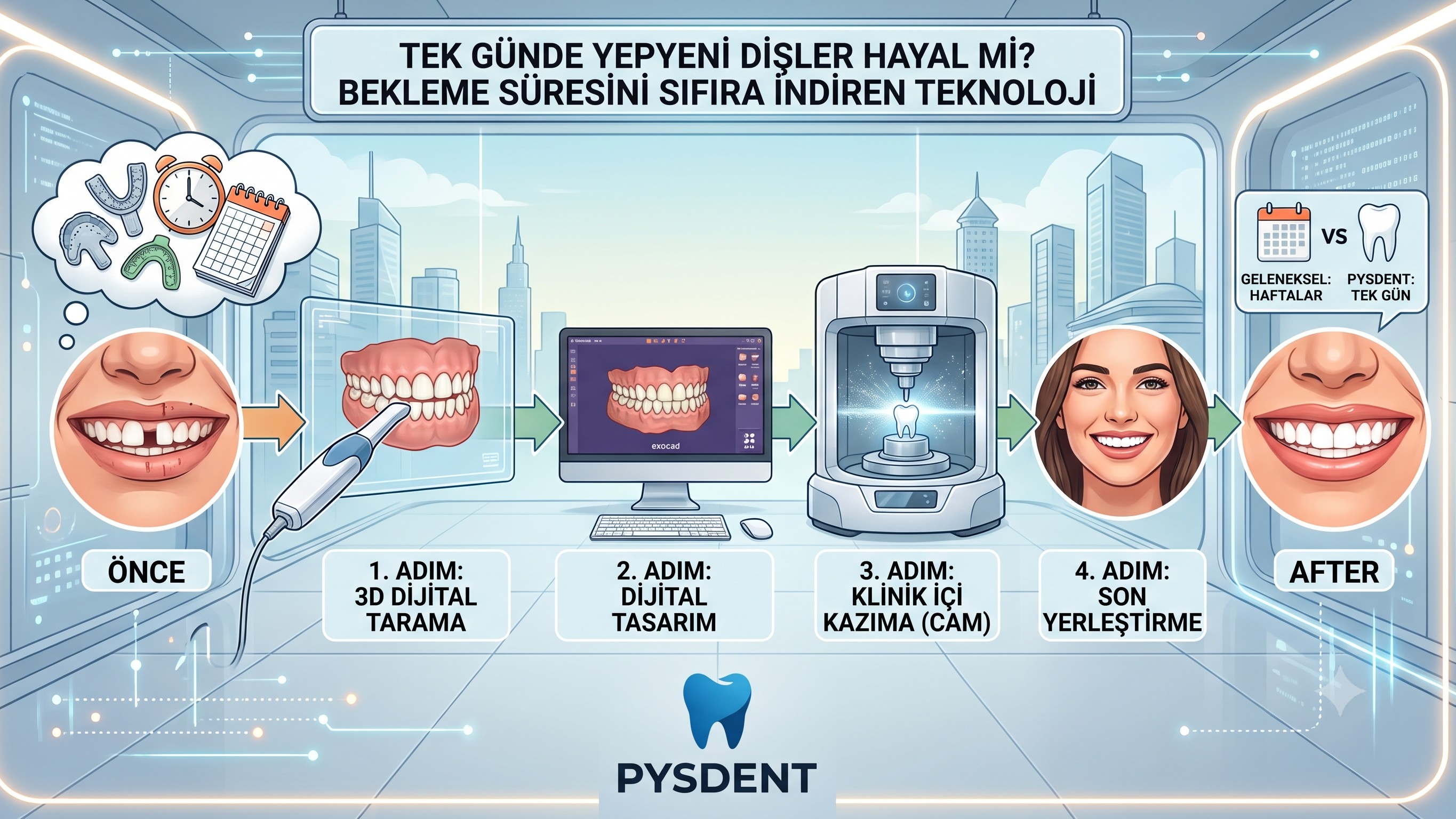
Are Brand New Teeth in a Single Day Just a Dream? The Technology Reducing Wait Times to Zero
27 July 2026 Smile Guide Mustafa PAYASIn the fast-paced tempo of modern life, time has become our most valuable treasure. Amidst business life, social responsibilities, and daily rushes, dedicating time to our health—especially our oral and dental health—can sometimes be challenging. In the past, getting a dental restoration, veneer, or smile design was a tedious process that took weeks and required multiple visits to the clinic. However, with the revolutionary technological opportunities offered in 2026, the old rules in dentistry are being broken. The answer to the question "Is it possible to have new teeth in the same day?" is no longer a sci-fi dream, but an entirely accessible reality. Let's take a closer look at the details, scientific infrastructure, and the unique comfort this technology, which virtually reduces waiting times to zero, offers to patients.
Farewell to the Traditional Impression Nightmare: "New" Generation 3D Scanning
One of the moments patients dread most in the dentist's chair is those cold, metal impression trays and nausea-inducing impression pastes placed in the mouth. In traditional dentistry, this method used to create a mold of the tooth is both uncomfortable for the patient and contains microscopic margins of error due to the expansion or contraction of the material.
In today's current digital dentistry protocols, these pastes have been replaced by optical intraoral scanners working with micrometer precision. With a scanning process that takes only seconds, an exact 3D digital copy of your teeth, gums, and jaw closure is transferred to the computer screen. This new technology not only maximizes patient comfort but also brings the treatment process to incredible speeds by allowing the acquired digital data to be instantly transmitted to the laboratory or in-clinic design computer.
What is CAD/CAM Technology and How Does It Work?
At the heart of the same-day dentistry (chairside) concept lies CAD/CAM (Computer-Aided Design / Computer-Aided Manufacturing) technology. This system completely eliminates waiting times. The workflow proceeds as follows:
-
Scanning and Data Collection: The digital impression obtained with the intraoral scanner is instantly transferred to the computer.
-
3D Modeling and Design (CAD): The dentist designs the form, size, and harmony of the tooth with surrounding tissues in a digital environment. Millimetric calculations are made to adjust the contact points with neighboring teeth flawlessly.
-
Manufacturing and Milling (CAM): Once the design is approved, the data is sent to the in-clinic 3D milling machine. High-quality porcelain or zirconium blocks are carved into the designed tooth in minutes using diamond-tipped burs.
-
Baking and Polishing: The milled tooth is sintered in special furnaces to gain its final durability and natural shine, and polished to be ready for application in the patient's mouth.
This entire process is completed in just a few hours while the patient sips their coffee in the waiting room.
Digital Vision in Kayseri: The Pysdent Approach
The speed and perfection offered by digital dentistry only truly succeed when backed by the right vision, advanced software knowledge (like Exocad 3D modeling programs), and physician experience. Elevating oral and dental health standards in the Kayseri region, Pysdent fully integrates this technological infrastructure into its clinic, offering patients a timeless and comfortable experience.
The expert staff managing the digital workflow for patients at Pysdent, including Dt. Koray Çataloluk, Dt. Mustafa Payas, Dt. Fatih Ballı, and Dt. Nida Nur Soyuer, adopt a multidisciplinary approach in same-day tooth delivery processes. Evaluating cases and planning the digital smile design according to the patient's facial features and the golden ratio transforms into a blend of technology and art, thanks to the clinical experience of the dentists. When the speed of technology is combined with the meticulous approach of the physicians, the result is not only fast but also long-lasting and aesthetically flawless.
Dental Treatment and Pricing Dynamics in 2026
One of the most frequently asked questions by patients is the cost of such advanced technology. In digital dentistry, fee policies are much more transparent and understandable compared to previous years. However, the factors affecting prices in treatment planning are quite diverse, and individual situations directly determine the cost.
The main elements shaping costs in same-day dental treatments are:
-
Quality and Type of Material Used: Will zirconium blocks or glass ceramics like lithium disilicate (E.max) be used in the treatment? The light transmittance, durability, and brand of the material are the most crucial elements changing the price.
-
Complexity of the Case: The design and production times—and consequently the costs—differ between a single tooth restoration and a full-jaw smile design or implant-supported same-day prosthesis applications.
-
Technological Infrastructure and Software Licenses: The up-to-dateness of the scanners used by the clinic, the licenses of the design software, and the precision quality of the production millers require a serious background investment. While these investments increase service quality, they are also reflected in cost items.
-
Experience of the Dentist: The dentist's expertise in digital modeling and aesthetic foresight using the technology is at least as valuable as the devices.
At first glance, high-tech treatments may seem to require a slightly higher budget compared to traditional methods; however, considering the absence of laboratory waiting times, no need for temporary teeth, and saving the patient from the cost of traveling back and forth to the clinic repeatedly (transportation and time), it is clearly seen as a much more economical and advantageous investment in the long run.
Don't Compromise on Quality While Saving Time
Same-day dental treatment (Single-visit dentistry) is an ideal solution not only for patients in a hurry or health tourism patients coming from out of town or abroad but for any individual who dreads needles, anesthesia, or spending long periods in a clinical environment. Waiting for days, sometimes weeks, with temporary teeth after taking an impression, experiencing that sensitivity, and carrying the anxiety of whether the tooth will fit are completely left in the past.
Since restorations produced with a digital workflow calculate microscopic details that the human eye might miss using computer algorithms, gingival harmony is flawless. This is a major shield in preventing future problems such as gum recession, decay under the restoration, and odor.
In summary, in the current dentistry world of 2026, you can spend your time sharing your new and healthy smile with your loved ones, rather than in the clinic. If you are tired of treatments that take weeks and want to meet this comfort offered by technology, you can take the first step to explore the possibilities of digital dentistry.

0 Yorum
Yorum Yaz